

When your business needs help, it’s easy to jump straight to a job title.
“I need a VA.” “We need a marketer.” “Maybe it’s time to hire another employee.”
Those labels feel useful because they give you something concrete to look for. But they can also push you toward a solution before you’ve clearly defined the problem.
A better support decision starts one step earlier. Before deciding who you need, break down the work itself. Look at the expertise involved, how often the work needs to happen, and where ownership makes the most sense. Then decide what kind of business support you actually need.
The Job Title Is Usually a Shortcut
Job titles bundle a lot of assumptions into a few words.
When you decide you need a VA, marketer, employee, or freelancer, you may already be making assumptions about the skills required, the amount of work involved, and the kind of commitment the business needs.
The role itself isn’t the problem. Any of those options could be right. The problem is deciding on the role too early.
Say you decide you need a marketer. You may start looking for one person to handle everything currently sitting in the marketing bucket. But that work could include strategy, graphic design, email setup, website updates, reporting, and administrative coordination.
Those tasks don’t necessarily require the same expertise, frequency, or person.
When you define who you need before defining the work, you’re asking a job title to solve a problem you haven’t fully examined yet.

Break the Work Apart Before
You Put It Back Together
Instead of starting with a role, start by separating the work into its individual parts.
Look at each piece across three dimensions:
- Expertise: What skill level or specialization does this work actually require?
- Frequency: Does it need to happen continuously, periodically, or for a specific project?
- Ownership: Should it stay with you, move to someone already on your team, or be handled by outside support?
This often reveals that what looked like one role is actually several different kinds of work.
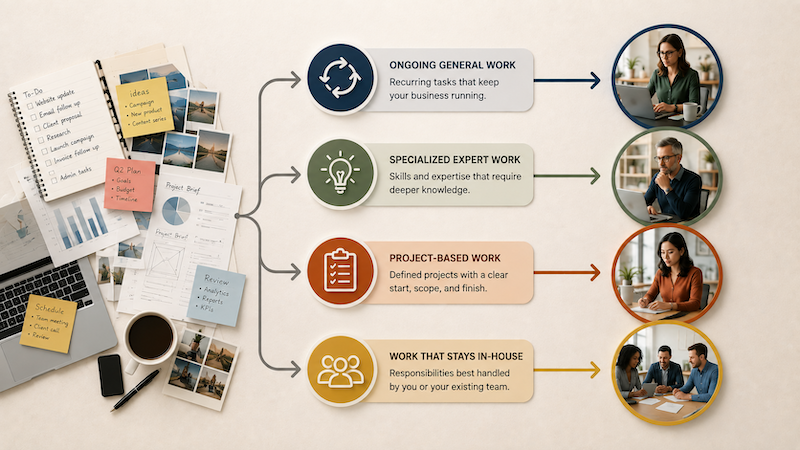
Some tasks may require specialized expertise. Others may be repeatable responsibilities that general ongoing support can handle. Still others might happen once a quarter or only during a specific project.
That distinction matters.
Bundle unlike work together and you can easily create a mismatch. You might pay for specialized expertise to handle routine tasks or hand specialized work to someone who doesn’t have the right skill set.
The point isn’t to divide every task among a dozen different people. It’s to understand what you’re actually asking for before deciding how the work should be packaged.
Check the Capacity You Already Have
Once the work is clear, look at the capacity that already exists in the business.
Some of it may belong with someone on your current team. But that doesn’t automatically mean it should be added to their workload.
Available capacity and theoretical capacity are two different things.
An employee may technically be able to perform a task while already being stretched thin. Adding more simply because they’re on payroll doesn’t solve the capacity problem. It moves the bottleneck.
Capability matters too.
In a small business, people often pick up responsibilities outside their primary expertise because someone has to get them done. That may work for a while, but availability shouldn’t be confused with fit.
Ask whether the person has both the capacity and the appropriate skill level to own the work effectively. If not, you’ve learned something useful before spending money on additional support.
Now Decide Who the
Work Actually Requires
Only after you understand the work and your existing capacity does it make sense to decide what type of support should handle what remains.
Depending on what you uncover, that could mean existing team ownership, general ongoing support, specialized expertise, project-based outside support, or a more permanent role when the volume and nature of the work genuinely support that commitment.
There doesn’t have to be one answer for the entire workload.
One part may belong with your existing team. Another may require a specialist for a defined project. A third may need consistent general support.
That can be a much stronger structure than forcing everything into one catch-all position simply because the title is familiar.
It’s also why questions like “Should I hire a freelancer or an employee?” or “Should I outsource this?” are difficult to answer in isolation.
The better question is: What does the work actually require?
Better Hiring Decisions
Start One Step Earlier
The hiring decision is downstream from the work decision.
Instead of moving directly from “we need help” to “who should we hire?”, use a more deliberate sequence: define the work, identify the expertise and frequency involved, check existing capacity, determine the appropriate type of support, and then decide who should do it.
That gives you a clearer basis for evaluating your options. You’re no longer trying to make a familiar job title fit a loosely defined collection of needs.
And that shift matters. The goal isn’t simply to fill a role. It’s to build the support structure the business actually needs now, without creating unnecessary overhead or solving one capacity problem by creating another.
If you know your business needs help but aren’t sure what type of support makes sense, take The Outsource Authority’s free Business Support Assessment. It can help you identify your biggest support challenges, understand their importance and urgency, and get personalized guidance on the type of support that may make sense before you make a hiring decision.