

The Hidden Hiring Mistake
Most Founders Make
When business owners look for freelance help, they usually compare options horizontally.
They scroll through profiles.
They compare hourly rates.
They read reviews.
They look through portfolios.
From the outside, it appears that dozens of people offer roughly the same service at different prices.
But that comparison method hides the real difference between freelancers.
The most important distinction is not horizontal. It is vertical.
Freelancers operate at different skill tiers. Each tier represents a different level of responsibility, complexity, and decision-making. When founders miss this distinction, hiring quickly becomes confusing.
One freelancer quotes $40 per hour. Another quotes $120 for what appears to be the same work. One promises fast delivery. Another asks detailed questions about goals and strategy before providing a price.
Without a framework, the differences can feel random.
In reality, you are often looking at different levels of what could be called a Freelancer Skill Ladder.
When founders do not recognize this ladder, two costly patterns show up. They either overpay for work that only requires basic execution, or they hire someone who lacks the experience needed for a more complex problem.
Both lead to frustration, wasted time, and unnecessary cost.
Once you understand the skill ladder, freelance hiring becomes far easier. Instead of treating freelancers as interchangeable providers, you begin identifying what level of expertise the work actually requires.

Why Freelancer Pricing Feels Inconsistent
Many founders feel confused by freelance pricing.
Two people offering the same service can charge dramatically different rates. A designer might charge $30 per hour while another charges $150. A writer might quote $100 for an article while another charges $800.
At first glance, the difference feels arbitrary.
The confusion usually comes from assuming that pricing reflects effort. In reality, freelance pricing often reflects expertise and responsibility.
Within almost every freelance category, there are multiple skill tiers.
Someone who completes clearly defined tasks will usually charge far less than someone responsible for solving a complex problem or determining the solution itself.
This is where many hiring decisions go off track.
If the task appears simple, a higher rate can feel unreasonable. But if the work requires judgment, experience, or strategic thinking, the higher rate often reflects the value of those capabilities.
The reverse mistake happens just as often.
A founder hires a lower-cost freelancer for work that actually requires deeper expertise. The freelancer completes the assignment exactly as requested, but the result falls short because the real problem was never properly addressed.
The issue is rarely effort.
The issue is skill tier alignment.
Once you start viewing freelancers through this lens, pricing differences make far more sense. What looks inconsistent on the surface usually reflects different levels of capability and responsibility.
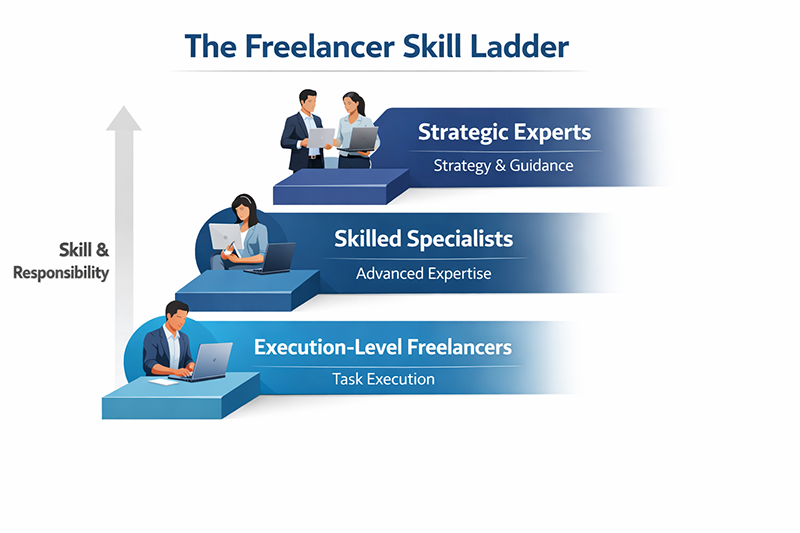
The Freelancer Skill Ladder Explained
A useful way to evaluate freelance support is to think in terms of three common tiers.
- Execution-Level Freelancers
These freelancers focus on completing clearly defined tasks. Instructions are provided, and their role is to execute efficiently and accurately. Examples include data entry, formatting work, uploading content, or simple design tasks. - Skilled Specialists
Specialists bring deeper expertise within a specific discipline. They can implement solutions and make informed decisions within their area of focus. Examples include experienced designers, copywriters, developers, and paid advertising specialists. - Strategic Experts
Strategic experts operate at a higher level of responsibility. They help define the problem, determine the best approach, and guide execution. They often function as consultants, strategists, or senior operators in their field.
The difference between these tiers is not simply talent.
The real differences are autonomy, complexity, and decision-making responsibility.
Execution-level freelancers follow instructions.
Specialists apply expertise to carry out a solution.
Strategic experts help determine what the right solution should be.
Many founders unintentionally collapse these into just two categories: inexpensive freelancers and expensive freelancers.
In reality, there are three distinct levels of capability. Recognizing that difference makes hiring decisions far more predictable.

Matching Freelancer Skill
to Work Complexity
Hiring problems usually happen when the complexity of the work does not match the freelancer’s skill tier.
Common alignment mistakes include:
- Hiring a strategist for work that only requires basic execution
• Hiring an execution-level freelancer for work that requires expertise
• Expecting strategic thinking from someone hired only to perform tasks
• Bringing in a specialist before clearly defining the objective
Each situation creates friction, but for different reasons.
When a strategist is hired for simple execution work, the founder ends up paying for capabilities that are never used. The project still gets completed, but the cost feels excessive because the assignment never required strategic input.
The opposite situation tends to be more frustrating.
A founder hires an execution-level freelancer for work that actually requires expertise. The freelancer follows the instructions exactly as given, yet the outcome still misses the mark. The founder may feel disappointed, while the freelancer believes they delivered what was requested.
Neither person is wrong.
The real problem is structural misalignment between the work and the skill level hired to complete it.
Over time, this mismatch leads many founders to believe freelancers are unreliable, when the real issue was simply hiring the wrong tier of expertise.

How Founders Can Identify
the Right Skill Tier
Before searching for freelancers, it helps to clarify the nature of the work itself.
Ask a few simple questions:
Is the work clearly defined, or is the path forward still uncertain?
Does the task require professional judgment, or straightforward execution?
Will the freelancer design the solution, or simply implement instructions?
What happens if the decision is wrong?
These questions quickly reveal how much expertise the situation actually requires.
Once the complexity becomes clearer, a simple tier test can help guide the decision.
- If the work is fully defined and only needs completion, an execution-tier freelancer is usually appropriate.
- If the goal is clear but the implementation requires professional expertise, a specialist tier freelancer makes sense.
- If the right approach is still uncertain and guidance is required, a strategic-tier freelancer is often the right choice.
This approach shifts the hiring process from profile comparison to decision clarity.
Instead of asking which freelancer looks best on a platform, the founder first determines what level of capability the project actually requires.
The search then becomes far more focused.

Why Understanding Skill
Tiers Protects Your Budget
Most founders care about two things when hiring support: protecting cash flow and maintaining momentum.
Misjudging freelancer skill levels can disrupt both.
When founders hire a higher-tier freelancer for work that does not require that expertise, the result is unnecessary spending. The work gets done, but the return on that investment is lower than it should be.
Under-hiring creates a different kind of loss.
A lower-tier freelancer may complete the assigned tasks, but the outcome falls short because the project required deeper expertise. The founder then spends additional time revising the work, bringing in someone new, or correcting earlier decisions.
Both scenarios waste resources.
Understanding freelancer skill tiers prevents these patterns. Instead of focusing only on price, founders begin matching the level of expertise to the complexity of the work.
That alignment improves outcomes and makes freelance spending far more predictable.
Over time, freelance hiring becomes less reactive and more intentional. Instead of scrambling for help when something breaks, founders begin building flexible support around the real needs of the business.
The Skill Ladder as a Decision Tool
Once founders understand the Freelancer Skill Ladder, hiring decisions become much simpler.
Before opening a freelance platform or asking for referrals, the first step becomes identifying the appropriate skill tier. That quick assessment clarifies what type of support is actually needed.
This reduces overwhelm when reviewing freelancers because you are no longer comparing every possible option. You are evaluating candidates who operate at the right level for the project.
Instead of reacting to profiles, reviews, and pricing differences, the founder begins with a structured decision model.
The skill ladder does not replace judgment, but it provides a practical framework for evaluating freelance expertise. With that structure in place, choosing the right freelancer becomes far more straightforward.
Not every business support problem calls for the same solution. Take The Outsource Authority’s free Business Support Assessment to identify where you need support most, understand what deserves attention now, and get personalized guidance on the type of support that may make sense for your business.