

Most conversations about business growth eventually come back to the same topics: sales, marketing, or productivity. Those are all important, but they rarely explain why a business stops growing.
More often, the real constraint is capacity.
As your business grows, so do the decisions, projects, customer requests, and operational demands. If every new responsibility continues to land on your desk, growth slows no matter how efficient or productive you become.
That’s why capacity deserves more attention than productivity. Productivity helps you get more done personally. Capacity determines how much your business can accomplish as a whole.
Businesses that intentionally build capacity can respond faster, take advantage of new opportunities, and continue growing without automatically increasing stress or fixed overhead.

Most Growth Problems Are
Actually Capacity Problems
When growth starts to stall, many business owners assume they need better time management or another productivity system.
That may provide temporary relief, but it doesn’t address the underlying issue.
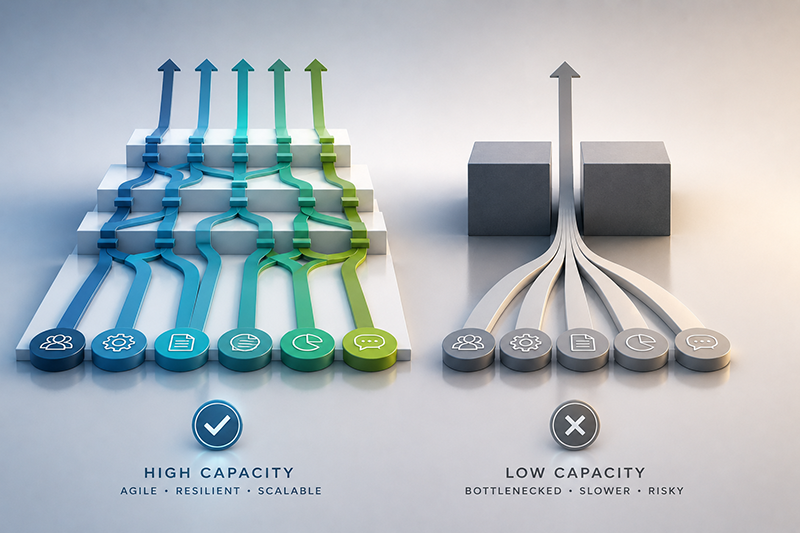
Every owner has a limit to the number of decisions they can make, projects they can oversee, and responsibilities they can manage well. Once that limit is reached, bottlenecks begin to appear. Projects wait for approval, customer requests take longer to fulfill, and opportunities are delayed simply because there isn’t enough bandwidth to move them forward.
At that point, the business isn’t struggling because people are inefficient. It’s struggling because too much depends on one person.
Businesses that continue growing recognize this shift early. Instead of asking, “How can I fit more into my day?” they ask, “How can the business handle more without relying on me for everything?”
That change in thinking creates room for sustainable growth instead of short-lived productivity gains.
What Business Capacity Really Means
Business capacity is your company’s ability to consistently deliver results without the owner absorbing every new responsibility.
It includes available time, decision-making capability, documented systems, and access to the right skills when they’re needed.
Capacity is often confused with productivity, but they’re solving different problems.
Productivity focuses on how efficiently one person completes tasks. Capacity focuses on how effectively the business functions as a system.
An owner can be incredibly productive and still become the biggest obstacle to growth if every approval, decision, or critical task depends on them.
Increasing capacity means reducing those dependencies so the business can continue moving forward as demands increase.
It also creates resilience. When work is supported by clear processes, documented expectations, and the right people, the business is far less vulnerable when plans change or unexpected challenges arise.
Four Practical Ways to
Increase Capacity
Building capacity isn’t about finding one perfect solution. It’s about strengthening several areas of the business so they work together.
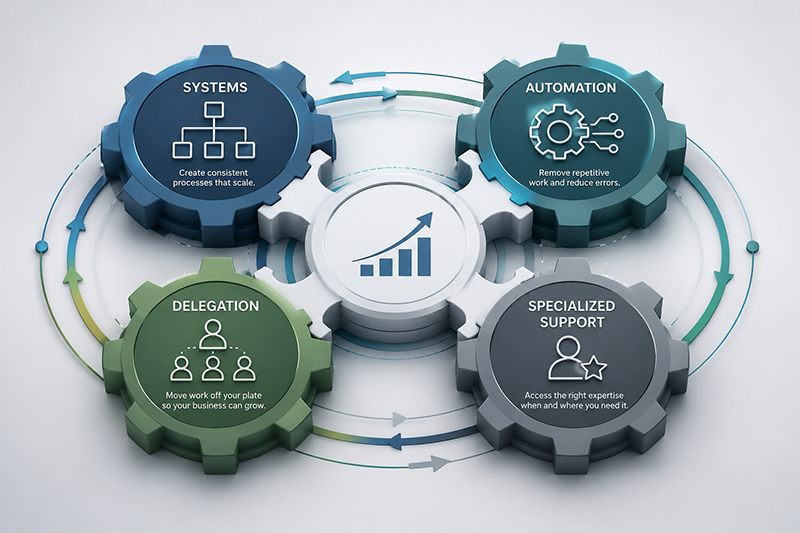
Start by focusing on four areas:
- Improve systems so recurring work follows consistent processes.
- Automate repetitive administrative tasks where it makes sense.
- Delegate work that doesn’t require your expertise.
- Add specialized external support when skills or additional capacity are needed.
These strategies reinforce one another.
Well-designed systems reduce confusion and make delegation easier. Automation removes repetitive work that doesn’t require human judgment. Delegation allows you to spend more time on strategic decisions instead of routine execution. Flexible external support gives you access to specialized expertise without immediately increasing permanent overhead.
None of these approaches is a complete solution on its own. Together, they create a business that’s better equipped to grow.
Why Capacity Creates
a Competitive Advantage
Capacity influences far more than your workload.
When your business has room to operate, projects move forward faster because fewer decisions are waiting for the owner’s attention. Customers experience more consistent service because work isn’t constantly delayed by internal bottlenecks.
Additional capacity also creates flexibility.
Instead of choosing between serving today’s customers and pursuing tomorrow’s opportunities, you have the ability to do both. That makes it easier to launch new initiatives, respond to market changes, or take on larger projects without disrupting existing operations.
It also reduces founder dependency.
As responsibilities become clearer and decisions move closer to the people doing the work, owners regain time to focus on planning, business development, and long-term strategy rather than daily operational firefighting.
Perhaps most importantly, capacity allows businesses to grow without assuming every increase in workload requires another full-time employee. Strategic use of flexible support lets you expand capability while preserving agility and protecting margins.
Where Business Owners Get It Wrong
Many attempts to build capacity fail because owners solve the symptom instead of the cause.
Some hire before they’ve defined what kind of help they actually need. Others assume adding people will automatically fix operational problems, only to discover that unclear processes simply create more confusion.
Another common mistake is treating productivity as the answer to every challenge. A better calendar, another task management app, or longer working hours may improve personal output, but they rarely eliminate structural bottlenecks.
Some businesses also commit to permanent overhead before their needs have stabilized. In many situations, flexible support provides a better way to increase capability while preserving the freedom to adapt as the business evolves.
Waiting until you’re overwhelmed creates its own problems. Hiring decisions become rushed, priorities become unclear, and mistakes become more expensive.
Capacity is much easier to build intentionally than during a crisis.
Build Capacity Before You Need It
The strongest businesses don’t wait until they’re under pressure before improving their operations.
They gradually strengthen systems, refine delegation, document processes, and add support as the business grows. Each improvement makes the next stage of growth easier because the business isn’t rebuilding itself every time demand increases.
Support should be viewed as part of that long-term strategy, not simply as an emergency solution when the workload becomes unmanageable.
The objective isn’t to add more people. It’s to build a business that can consistently accomplish more without every new responsibility landing on the owner’s shoulders.
Growth becomes far more sustainable when capacity grows alongside it.
If you’re ready to build capacity by adding the right support at the right time, take The Outsource Authority’s free Business Support Assessment to clarify your biggest support challenges and get personalized guidance on what type of support may make sense before you make a hiring decision.