
As a business grows, it’s easy to assume the next step is hiring more employees. Sometimes that’s the right move. Often, it isn’t.
Adding headcount and increasing business capacity are not the same thing.
Growth brings more projects, more decisions, and more operational complexity. If every new challenge is met by hiring another person before understanding what’s actually slowing the business down, you can end up with more overhead but very little improvement.
A lean support structure takes a different approach.
Instead of asking, Who should I hire next? it asks, What’s preventing the business from operating more effectively?
That shift turns support into a strategic decision rather than a hiring exercise. The goal isn’t to build the biggest team. It’s to build the right combination of people, systems, and processes that allows your business to grow without unnecessary complexity.
Growth Doesn’t Always
Mean More Employees
Many successful businesses expand without dramatically increasing payroll.
They do it by matching support to the work instead of assuming every new responsibility requires a full-time employee.
A lean support structure isn’t about operating with as few people as possible. It’s about creating the right level of support for your current stage of growth while keeping enough flexibility to adapt as your business changes.
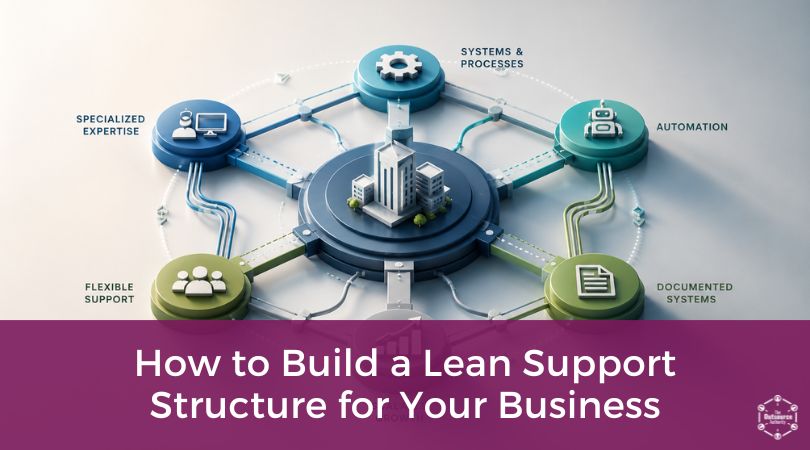
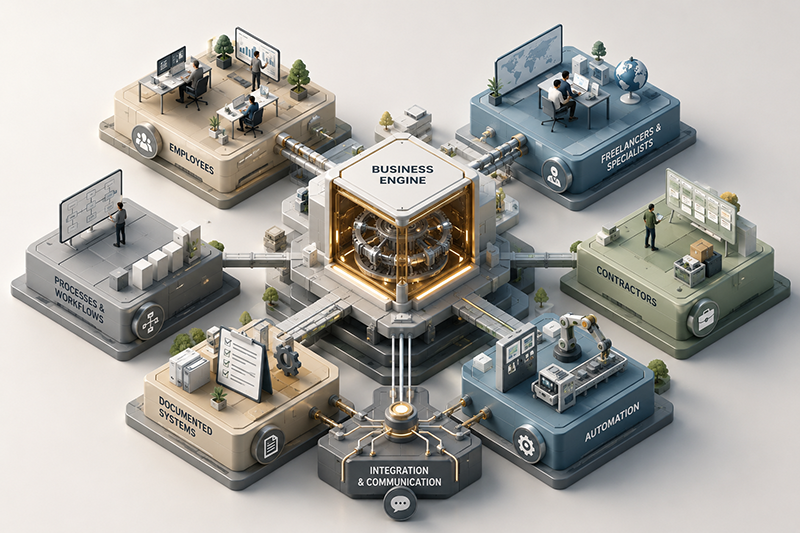
That support might include employees, freelancers, contractors, automation, documented systems, or a combination of all of them.
Each serves a different purpose, and each should solve a specific operational problem.
When support is built intentionally, the business becomes easier to manage. Growth no longer depends on the founder absorbing every new responsibility or rushing into permanent hiring decisions whenever workloads increase.

Start by Identifying the Constraint
Before adding support, identify what’s actually slowing the business down.
Many founders assume they need help simply because they’re busy. But being busy is usually a symptom, not the problem itself.
Most bottlenecks fall into one of three categories:
- Execution: Too much work depends on one person to get done.
- Decision-making: Projects stall because approvals or key decisions always wait for the founder.
- Coordination: Multiple people are involved, but responsibilities, communication, or workflows aren’t clearly defined.
Each bottleneck requires a different solution.
If you hire before identifying the real constraint, you may add capacity where it isn’t needed while leaving the actual problem untouched.
Diagnosing the issue first allows you to build support that removes the bottleneck instead of adding unnecessary complexity.
Build a Flexible Support Structure
A lean business rarely relies on just one type of support.
Instead, it combines different resources, each contributing in a specific way.
- Employees provide continuity for core business functions and long-term responsibilities.
- Freelancers and specialists bring expertise when a project requires skills you don’t need every day.
- Contractors can increase capacity for ongoing initiatives while preserving flexibility.
- Automation handles repetitive administrative work that doesn’t require human judgment.
- Systems and documented processes connect everything together, creating consistency and making it easier for others to contribute effectively.
None of these components is designed to replace the others.
Together, they create a support structure that can adapt as your business grows without forcing you into unnecessary overhead or rigid staffing decisions.
Design Roles Around Problems,
Not Job Titles
One of the most common hiring mistakes is starting with a title instead of an outcome.
Business owners often decide they need an Operations Manager, Executive Assistant, or Marketing Coordinator before they’ve clearly identified what that person is expected to solve.
Start with the business problem instead.
Is client onboarding slowing delivery? Is project coordination consuming too much of your time? Are marketing initiatives being delayed because no one has specialized expertise?
Once the problem is clearly defined, the right solution usually becomes much easier to identify.
Sometimes that solution is a full-time employee. Other times it’s a freelancer with a specific skill, an automated workflow, or a documented process that removes unnecessary work altogether.
Roles should exist because they eliminate bottlenecks, not because they fit a traditional organizational chart.
Protect Founder Capacity
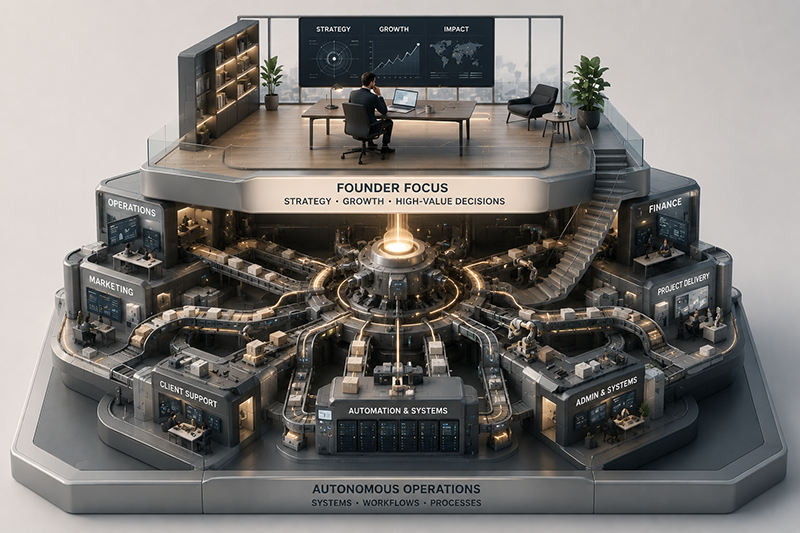
Founder capacity is one of the most valuable resources in a growing business.
Every hour spent answering routine questions, coordinating projects, or handling repetitive administrative work is an hour that can’t be invested in strategy, customer relationships, or business development.
A well-designed support structure protects that time.
When responsibilities are clearly assigned, systems are documented, and decision-making is shared appropriately, founders spend less time keeping the business running and more time moving it forward.
That doesn’t mean stepping away from important decisions.
It means making sure your expertise is reserved for the work where it creates the greatest value instead of becoming the default solution to every operational issue.
Businesses become far more scalable when they rely on systems and clearly defined responsibilities rather than constant founder involvement.
Keep Your Support Structure Flexible
A lean support structure isn’t something you build once and forget.
As your business evolves, priorities shift, new opportunities emerge, and operational demands change. Your support structure should evolve alongside them.
Review your systems, processes, and support regularly to make sure they still match the needs of the business. Some responsibilities may expand, others may disappear, and new areas of expertise may become important.
Maintaining flexibility is often more valuable than building a rigid organizational structure too early.
The objective isn’t to create the smallest team possible.
It’s to create a business that consistently increases its capability without accumulating unnecessary complexity or overhead.
The Bottom Line
Building a lean support structure isn’t about hiring fewer people. It’s about making better decisions about how work gets done.
When you identify constraints before adding support, define roles around business problems, strengthen your systems, and combine employees with flexible expertise where it makes sense, you create a business that’s built to grow without unnecessary overhead.
If you’re ready to add freelance support strategically, download How to Find Quality Freelancers Who Actually Deliver. It will help you evaluate freelancers with confidence, avoid common hiring mistakes, and build a support structure that grows with your business.