

Doing everything yourself is often the right decision when you’re building a business.
In the early days, you’re wearing every hat because it makes financial sense. You’re handling sales, marketing, customer service, administration, and operations while learning how your business actually works. Every dollar matters, and taking on multiple roles is often the smartest way to get started.
The challenge is that what works in one stage of business can become a liability in the next.
As your business grows, your time becomes increasingly valuable. The same DIY approach that once saved money can eventually limit revenue, slow execution, and keep your attention on work that no longer needs to be done by you.
DIY is a smart strategy. It just isn’t meant to be a permanent one.
The key is recognizing when you’ve reached the point where doing everything yourself is costing more than it’s saving.
DIY Is Smart Until It
Becomes the Bottleneck
There’s nothing wrong with wearing multiple hats when your business is small.
In fact, most successful business owners start that way. Learning new skills, solving problems yourself, and being careful with spending helps you build a stronger understanding of how your business operates while keeping expenses under control.
Eventually, though, the business changes.
More customers need support. Projects become more complex. Decisions multiply. Opportunities appear more often. The one thing that doesn’t increase is the number of hours in your day.
At some point, your time becomes the most limited resource in the business.
That’s when continuing to do everything yourself stops being efficient and starts becoming the bottleneck that limits growth.
Recognizing that shift isn’t a sign that you’ve failed to stay lean. It’s a sign that your business has outgrown its original operating model.

The Hidden Costs of
Doing Everything Yourself
The cost of DIY rarely appears on a profit and loss statement.
Instead, it shows up in the opportunities you never have time to pursue.
Revenue-generating work gets pushed aside because administrative tasks consume the day. Important projects take weeks instead of days because one person is responsible for every step. Strategic planning gets replaced by an endless cycle of reacting to whatever feels most urgent.
Decision fatigue adds another layer of pressure.
When every question, approval, and problem lands on your desk, your mental bandwidth becomes just as limited as your available time. Even routine decisions begin competing with the ones that genuinely require your attention.
Customer experience often suffers too. Slower response times, delayed project delivery, and postponed improvements are frequently the result of limited capacity rather than poor service.
These costs can be difficult to measure, but they have a direct impact on growth. Saving money by avoiding outside support becomes an expensive strategy if it consistently prevents your business from moving forward.
Five Signs You’ve Reached
the Tipping Point
DIY may no longer be serving your business if you notice these patterns:
- Revenue-generating work is regularly postponed.
- Routine administrative tasks consume a large portion of your day.
- Important projects stay unfinished because there isn’t enough time.
- Decisions are delayed because everything requires your input.
- The business struggles to function without your direct involvement.
One of these issues on its own isn’t necessarily a problem. When several appear at the same time, it’s usually a sign that your capacity has reached its limit.
That doesn’t automatically mean you need to hire someone tomorrow. It does mean it’s time to evaluate how work flows through the business and whether your current approach is still supporting your goals.
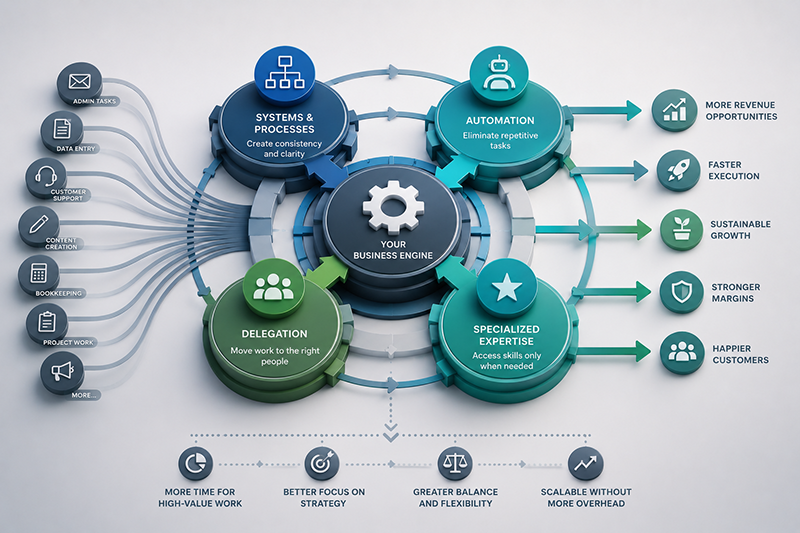
Replace DIY With Leverage,
Not More Work
Moving beyond DIY doesn’t mean building a large team overnight.
In many cases, the first step is improving how work gets done.
Clear systems reduce confusion and make recurring tasks easier to complete consistently. Automation can eliminate repetitive administrative work that doesn’t require human judgment. Delegation allows you to move lower-value work to capable support while protecting your own time for decisions that have the greatest impact.
Sometimes the missing piece is specialized expertise.
Bringing in a freelancer for technical work, design, bookkeeping, marketing, or another specialized project gives you access to the skills you need without immediately increasing permanent overhead.
The goal isn’t to hire simply because the business is growing.
The goal is to remove the constraint that’s slowing the business down.
Sometimes that means documenting a process. Sometimes it means automating repetitive work. Sometimes it means adding flexible support. The right answer depends on the problem you’re trying to solve.
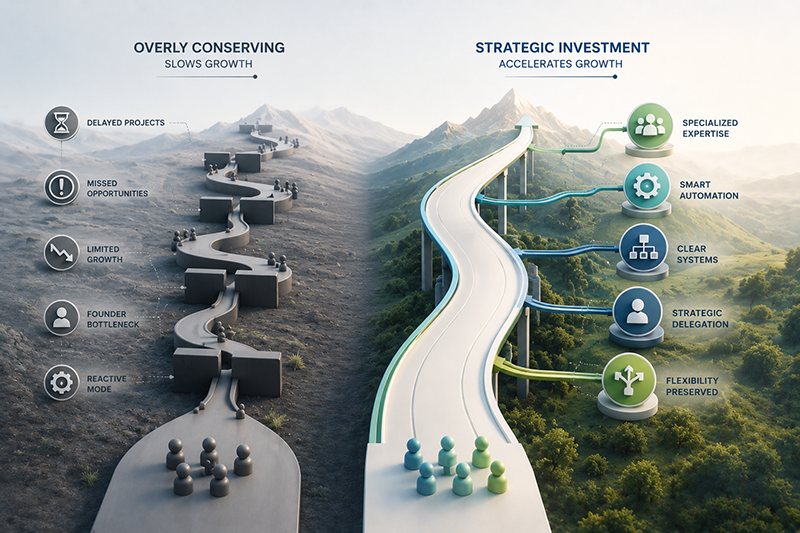
Saving Money Shouldn’t Cost You Growth
Managing expenses carefully is part of running a healthy business.
The challenge is remembering that visible savings are only part of the equation.
Avoiding outside support may reduce costs today, but if it also delays revenue, slows execution, or causes you to miss opportunities, those savings come with a hidden price.
The better question isn’t, “How do I spend less?”
It’s, “Where will the right investment create the greatest leverage?”
That’s often where flexible support provides the greatest value. Instead of committing to unnecessary overhead, you increase your capacity only where it strengthens the business and supports continued growth.
The Bottom Line
DIY plays an important role in building a business, but it should be viewed as a stage, not a permanent operating model.
As your business grows, your greatest contribution becomes less about completing every task yourself and more about making sure the right work is being done by the right people, systems, and processes.
When you recognize the hidden cost of doing everything yourself, you can make more deliberate decisions about where to invest your time and where additional support creates the greatest return.
If you’re considering adding flexible support but want to make informed hiring decisions first, download How to Find Quality Freelancers Who Actually Deliver. It provides a structured approach to evaluating freelancers, avoiding common hiring mistakes, and deciding when outsourcing is the right next step for your business.