
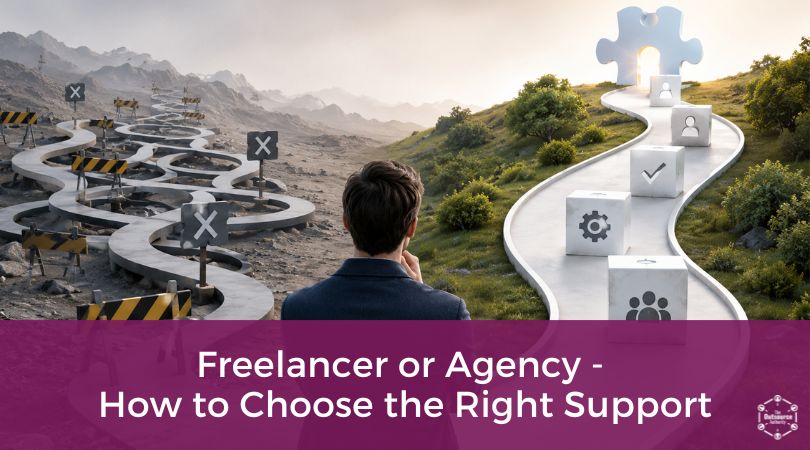
Every growing business reaches a point where extra help becomes necessary. That’s usually when the question comes up: should you hire a freelancer or work with an agency?
It sounds like the right place to start, but it often leads business owners down the wrong path.
Comparing provider types before you’ve defined the work can leave you paying for capabilities you don’t need or hiring someone who isn’t equipped for what the project actually requires. Price comparisons only add to the confusion because cost tells you very little about whether the support is the right fit.
A better way to approach the decision is to treat outsourcing as a business design question, not a marketplace comparison. The goal isn’t to decide whether freelancers or agencies are inherently better. It’s to identify which type of support best fits your business today.
When you start with the business problem instead of the provider, the right answer usually becomes much clearer.
The Wrong Question Leads
to the Wrong Decision
The freelancer-versus-agency debate assumes one option is generally better than the other. In reality, both can deliver excellent results when they’re matched to the right situation.
Problems usually begin when business owners choose based on assumptions rather than business requirements. An agency may feel like the safer choice because it has a larger team. A freelancer may seem like the budget-friendly option. Neither assumption guarantees a successful outcome.
Instead, ask yourself what you’re actually trying to solve.
Are you filling a temporary capacity gap? Do you need specialized expertise? Is this a one-time project or ongoing work? Will the project require several different skills that need to be coordinated?
Those questions reveal far more than comparing hourly rates or company size.
Think of support as part of your business architecture. The structure you choose should fit the work you need completed now while giving you enough flexibility to adapt as your business grows.

Start With the Work,
Not the Provider
Before deciding who to hire, define exactly what success looks like.
Many outsourcing frustrations don’t start with the freelancer or the agency. They start with vague expectations. If you can’t clearly explain the work, it’s difficult to choose the right type of support, and even harder to evaluate whether someone is qualified to deliver it.
Start by considering:
- The amount of work that needs to be completed
- The complexity of the work
- The level of expertise required
- Whether the work is ongoing or project-based
Each of these factors influences what kind of support makes the most sense.
A straightforward design project with a clearly defined scope may only require one experienced freelancer. On the other hand, a website launch involving copywriting, design, development, SEO, and project coordination may benefit from a team that can manage multiple moving parts.
Continuity matters too. If your business would be significantly affected by delays, backup coverage may be an important consideration. If the work is occasional or has a defined finish line, that level of redundancy may not justify the additional cost.
By defining the work first, you remove much of the guesswork from the hiring decision. You’re no longer choosing between labels. You’re selecting the structure that best supports the outcome.

When a Freelancer Is the Better Fit
A freelancer is often the right choice when the work is focused, well defined, and calls for a specific skill set.
Working directly with the person doing the work usually keeps communication simple. Questions are answered quickly, feedback loops are shorter, and over time they develop a stronger understanding of how your business operates.
Many freelancers build their careers around one specialty. Whether you need a copywriter, bookkeeper, designer, developer, or virtual assistant, someone who performs that work every day can often provide excellent value.
There are practical advantages as well.
Costs are typically lower because there isn’t an additional management layer built into the pricing. You also build a direct working relationship with one person rather than communicating through multiple people.
That doesn’t mean freelancers are always the right answer.
A solo freelancer has limited capacity and usually doesn’t have built-in backup. If they’re unavailable because of illness, vacation, or competing commitments, your project may pause until they return.
For many businesses, that’s perfectly acceptable. For others, particularly where day-to-day operations depend on consistent support, continuity may outweigh the savings.
Neither option is inherently better. The right choice depends on the role that support plays within your business.

When an Agency Makes More Sense
An agency becomes a stronger fit when the work requires more coordination, greater capacity, or multiple areas of expertise working together.
Instead of sourcing and managing several specialists yourself, you’re working with an organization that already has those resources in place. In many cases, you’ll have a single point of contact while the agency coordinates the work behind the scenes.
That can be valuable for projects such as a website redesign, a larger content marketing initiative, or a campaign that involves strategy, design, development, and ongoing execution.
An agency can provide advantages such as:
- Greater capacity for larger or higher-volume projects
- Access to multiple complementary skill sets
- Backup coverage if one team member becomes unavailable
- Project management and internal coordination
Those benefits come with trade-offs.
Agency pricing is generally higher because you’re paying for more than the technical work. You’re also covering project management, coordination, quality control, and the infrastructure required to deliver work consistently.
Communication may also be less direct. Rather than speaking with the person completing the work, you’ll often work through an account manager or project lead. For many businesses that’s a worthwhile trade, while others prefer collaborating directly with the specialist doing the work.
If your project genuinely requires that additional coordination, an agency can be an excellent investment. If it doesn’t, you may be paying for capabilities you won’t use.
Sometimes the Best Decision Is to Wait
Not every business is ready to outsource, and that’s perfectly okay.
If you can’t clearly describe the work, define what success looks like, or explain why you need help, bringing in outside support often creates more confusion than progress.
Poorly defined projects rarely fail because of the provider. They fail because expectations were never clear in the first place.
Sometimes the real bottleneck isn’t a lack of people. It’s a lack of process.
If responsibilities are constantly shifting, documentation is missing, or priorities change every few days, adding another person won’t solve the underlying issue. In some cases, it simply gives another person front-row seats to the chaos.
Taking time to document workflows, clarify priorities, or define project scope may produce better results than hiring immediately.
Delaying an outsourcing decision isn’t always procrastination. Sometimes it’s sound business judgment.

A Simple Framework for
Making the Decision
When you’re unsure which direction makes the most sense, work through a simple decision process.
- Define the business problem you’re trying to solve.
- Determine the level of expertise the work actually requires.
- Estimate the expected workload and volume.
- Decide whether continuity and backup coverage are important.
- Compare the cost of each option against the business risk of choosing the wrong one.
This shifts the conversation away from labels and toward practical decision-making.
For example, if the work is specialized, limited in scope, and benefits from direct collaboration, a freelancer may be the logical choice. If the project requires several specialists working together under coordinated management, an agency may provide the better solution.
The framework is intentionally simple because most outsourcing decisions become much easier once you’ve clearly defined the work.

Build a Support Portfolio
Instead of Choosing Sides
One of the biggest misconceptions about outsourcing is believing you have to pick one model and stick with it.
Most successful business owners don’t.
Instead, they build a flexible support portfolio that evolves with the business.
A trusted copywriter might handle recurring content. A freelance bookkeeper manages the finances each month. When it’s time for a major website redesign, an agency steps in to coordinate a larger project with multiple specialists.
Each provider serves a different purpose.
This approach gives you flexibility without unnecessary overhead while allowing you to match the right expertise to the right project. As your business grows, your mix of support can grow with it.
You aren’t making a permanent commitment to one outsourcing model. You’re making individual business decisions based on the work in front of you.
That flexibility often becomes one of your greatest operational advantages.
The Bottom Line
The decision between hiring a freelancer and working with an agency isn’t about finding the better provider. It’s about choosing the support structure that best fits your business today.
Start by defining the business problem. Understand the scope of the work, the level of expertise required, and how important continuity is to your operations. Once those pieces are clear, comparing providers becomes much more objective.
The businesses that outsource successfully aren’t necessarily the ones spending the most money. They’re the ones making deliberate decisions about the type of support they actually need.
When your support structure matches your business requirements, you make better use of your budget, reduce unnecessary complexity, and create a stronger foundation for growth.
If you’d like a practical framework for evaluating freelancers before you hire, download How to Find Quality Freelancers Who Actually Deliver. It will help you assess potential freelancers with more confidence, avoid common hiring mistakes, and make outsourcing decisions based on structure rather than guesswork.