

Most business owners don’t realize how vulnerable their operations become when too much responsibility sits with a single freelancer.
Your designer gets booked solid during a launch. Your VA takes unexpected time off. Your writer can’t accept new work for two weeks because their schedule is full. None of these situations mean anyone has done something wrong. They’re simply reminders that every freelancer has limits, competing priorities, and a life outside your business.
The real problem isn’t freelancer reliability.
The problem is building critical business functions around a single point of support.
Many businesses are one vacation, illness, scheduling conflict, or capacity issue away from stalled projects and unnecessary stress. A backup freelancer roster helps solve that problem by creating support depth before you need it.
This isn’t about building a massive outsourced team. It’s about creating a smarter support structure that protects continuity and gives your business room to grow.
The Risk of Relying on One Freelancer
Having a great freelancer is valuable.
Relying entirely on one freelancer for an important function is where the risk begins.
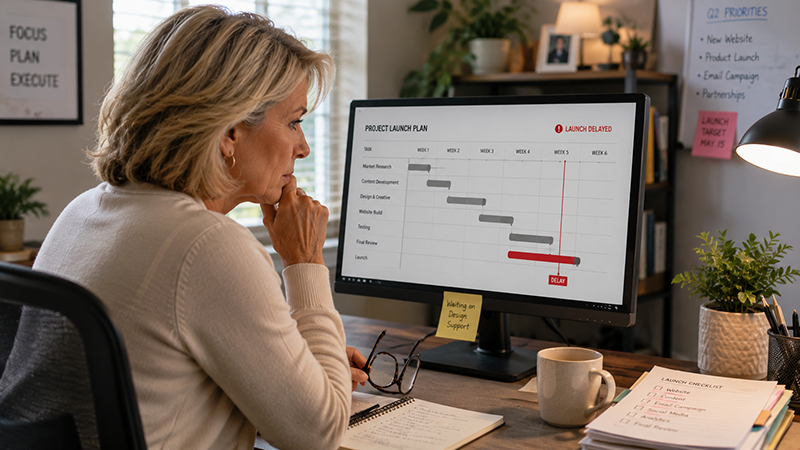
If one person handles all your administrative support, any disruption affects communication, scheduling, and day-to-day operations. If your designer becomes unavailable during a product launch, timelines shift whether you’re prepared or not. If your content writer reaches capacity, marketing execution slows down even when business demand is increasing.
The issue isn’t that freelancers are unreliable. Most are highly professional.
The reality is that freelancers serve multiple clients, manage changing workloads, and operate within finite capacity. That’s normal.
The challenge appears when a business has no alternative plan.
Growth can create a second problem. Even exceptional freelancers can only take on so much work. At some point, business momentum becomes tied to one person’s availability. Projects wait. Bottlenecks appear. Opportunities take longer to execute.
A backup freelancer roster reduces that dependency and creates flexibility when circumstances change.

What a Freelancer Roster
Actually Looks Like
When people hear “freelancer roster,” they sometimes picture a giant list of contractors.
That’s not what most businesses need.
A strong freelancer roster is simply a structured network of trusted support relationships built over time.
Most successful rosters include three types of relationships:
- Primary freelancers
These are the people you work with regularly. They understand your business, know your expectations, and handle recurring work. - Specialists
These freelancers provide expertise for specific projects or occasional needs. You may only engage them a few times a year, but the relationship already exists. - Backup support
These are vetted freelancers who can step in when primary support becomes unavailable or overloaded.
The important distinction is that these aren’t strangers you’re trying to hire during a crisis.
They’re people you’ve already researched, evaluated, and potentially worked with before.
That shifts outsourcing from reactive hiring to intentional support planning.
Over time, many business owners develop a reliable network of specialists they can call on when capacity, expertise, or circumstances require it. That network becomes part of the business infrastructure itself.
Which Areas Need Backup Coverage?
Not every business needs backup coverage for every role.
The goal is to identify the functions that would create the most disruption if support suddenly disappeared.
Administrative support is often one of the first areas worth strengthening. When inbox management, scheduling, client communication, or recurring operational tasks depend on one person, interruptions are felt immediately.
Content production is another common bottleneck. Writers, editors, video specialists, and social media support all have capacity limits. Additional options help maintain consistency when workloads increase.
Design support frequently benefits from backup coverage as well. Marketing campaigns, launches, presentations, and client deliverables often depend on design work being completed on schedule.
Technical support deserves consideration too. Website issues, automation problems, platform integrations, and troubleshooting rarely happen at convenient times. Businesses with established technical contacts typically recover much faster than those starting a search during an emergency.
The goal isn’t duplicating an entire team.
It’s ensuring that critical functions have support depth when needed.

How to Build a Freelancer Roster
Without Overcomplicating It
The good news is that building a roster doesn’t require a large hiring project.
Most business owners develop strong support networks gradually.
Start by identifying your biggest dependency. Ask yourself a simple question: if one freelancer became unavailable for the next two weeks, which absence would create the biggest operational problem?
That’s usually where backup coverage should begin.
From there, focus on testing additional support before you need it.
This matters because emergency hiring often leads to rushed decisions. When something breaks, it’s easy to prioritize speed over evaluation.
A better approach is to give potential backups small, low-risk projects during normal operations. This allows you to assess communication, reliability, responsiveness, and quality before any real pressure exists.
As new needs emerge, your roster can expand naturally.
You might begin with a primary VA and a backup. Later, you add a designer. Then a technical specialist. Then a content writer. Most strong freelancer networks grow through ongoing relationship development, not large-scale recruiting efforts.
Maintaining occasional contact also helps. A backup freelancer who hasn’t heard from you in eighteen months may not be available when you need them.
Simple relationship maintenance keeps those support channels active.
What a Strong Freelancer
Roster Makes Possible
The biggest benefit of a freelancer roster isn’t simply having more people available.
It’s the flexibility that support depth creates.
Projects move faster because work doesn’t depend entirely on one person’s schedule. Specialists can contribute simultaneously when needed. Execution becomes more adaptable without adding payroll or fixed overhead.
Timelines become more reliable as well.
When one freelancer’s availability changes, projects don’t immediately grind to a halt because alternative support options already exist.
A strong roster also allows businesses to scale capacity more intelligently. Instead of turning every growing need into a full-time hire, owners can increase support where necessary while maintaining flexibility and protecting margin.
Stress levels often decrease too.
Much of the anxiety around outsourcing comes from uncertainty. When there’s only one option, every disruption feels significant. When multiple trusted relationships exist, decision-making becomes much calmer.
Perhaps most importantly, a freelancer roster provides access to expertise when it’s needed.
Your business doesn’t need every skill in-house all the time. It needs reliable access to the right expertise when specific projects require it. That’s often a far more efficient approach to growth.
Moving Forward
A backup freelancer roster isn’t about collecting as many freelancer contacts as possible.
It’s about building support depth that protects continuity, reduces operational risk, and creates more flexibility as your business grows.
Businesses that rely entirely on one freelancer often discover the weakness in that structure only after a disruption occurs. Businesses with stronger support systems adapt much more smoothly because trusted alternatives are already in place.
The process doesn’t need to be complicated. Start by identifying one critical dependency and building one reliable backup relationship.
If you’d like a structured process for finding and evaluating freelance support, download the free guide How to Find Quality Freelancers Who Actually Deliver. It walks you through how to research, qualify, and communicate with freelancers more confidently so you can build stronger support relationships without unnecessary trial and error.